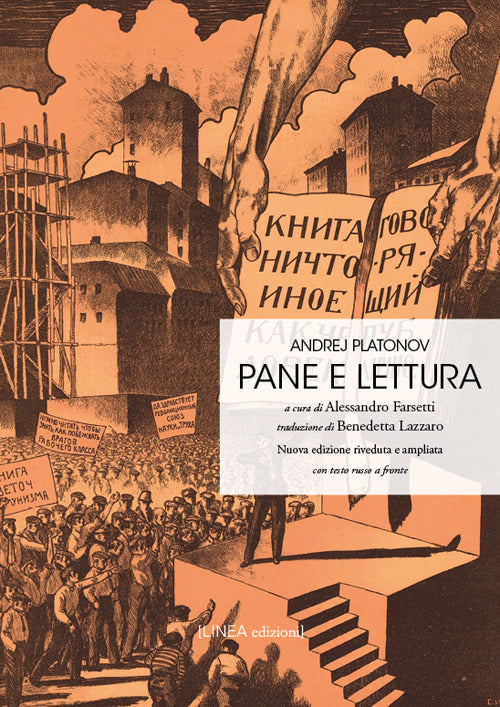
Pane e lettura (Хлеб и чтение)
Pane e lettura (Хлеб и чтение)
Couldn't load pickup availability
Share
It is one of Andrey Platonov’s lesser-known masterpieces. A significant work within the landscape of 1930s Soviet prose, the text was rediscovered in the KGB archives and published in full for the first time in Russia in 2000.
Set in the aftermath of the Bolshevik Revolution, the story unfolds in a remote Russian village populated by superstitious peasants exhausted by famine. At the heart of the narrative are two young electrical engineers, Semyon Dushin and Dmitry Shcheglov, who are tasked with the electrification of the countryside. The two men represent opposing worldviews: one rooted in scientism, the other in skepticism.
Far from championing either side, Platonov uses these characters to voice the ontological and existential doubts that surfaced within him in post-revolutionary Russia. The result is a human portrait not without its satirical moments, but one dominated by an affection for these 'little men' of the provinces—eccentric, yet sincere and suffering.
In this work, Platonov’s prose departs from the expectations of the era's official aesthetic—Socialist Realism—to reunite with the tradition of great Russian literature, which interrogates the structures of being and probes its own soteriological possibilities.
Author: Andrey Platonov (Андрей Платонов)
He was a Soviet Russian writer whose work was so ahead of its time—and so critical of the bureaucratic soul—that much of it was not published until decades after his death. He was the eldest of ten children. He began working at age 13 to support his family, eventually becoming an electrical engineer and land reclamation specialist. This technical background deeply influenced his prose, which often blends industrial metaphors with existential longing.
Initially a supporter of the Revolution, Platonov’s honest depictions of the famine and the "hollowness" of Soviet bureaucracy soon drew the ire of Joseph Stalin, who famously labeled him a "scum." By the 1930s, Platonov was effectively banned from publishing. He spent his later years working as a war correspondent during WWII, but eventually died in poverty and obscurity from tuberculosis (contracted while nursing his son, who had returned from a Gulag).
Language(s): Italian and Russian
Themes: Literature and Historical fiction
Publisher: LINEA edizioni
Format: Paperback
Pages: 320
View full details